Before I start any exercise on the section 3, I want to take quick look of the vocabulary first. The description in the class note makes me feel more confused, so I wonder around looking for other explanations.
I find this page with examples:
http://www.colorcube.com/articles/theory/theory.htm
http://www.wetcanvas.com/forums/showthread.php?t=205964
So from what I understand,
different Hue = different colour
High Chroma = Purer the colour with no mix of black and white; No Chroma = grey scale
High Value = Brighter the colour, the highest value will make everything white
In the colour cube, there are three axis. They can be span by Hue/Chroma/Brightness, or Hue/Saturation/Value. So I should look at Saturation the same as Chroma.
In the discussion that there are people dispute about Chroma and Saturation, but I think three axis should be enough to span the colour space and create most of the colour. Therefore, other naming will contain some sort of duplication in definition. I think there are just too many dials in photo editor these days.
Thursday, 9 February 2012

Wednesday, 8 February 2012
Comment: Quote from Philippe Halsman
I came across a quote that I really like, from a photographer names Phillippe Halsman. It reminds me the discussion of the on-going (still?) discussion about photographer.
“I drifted into photography like one drifts into prostitution. First I did it to please myself, then I did it to please my friends, and eventually I did it for the money.”
Read more about his life here:
http://www.professionalphotographer.co.uk/Legends/Interviews/Philippe-Halsman-Profile
and here
http://www.npg.si.edu/exh/halsman/intro.htm
Tuesday, 7 February 2012
Assignment 2: Elements Of Design
So exhausted. Somehow I keep thinking that I will never be able to produce all the shots for submission.
The subject I have chosen for this assignment is "glass". It follows from the fact that the "transparent" shot is the weakest shot. Now I have the whole assignment to try to fix that.
Here are the shots that I submitted. There are totally 14 of them.
Rhythm


Diagonal


Two Points

Multiple Point in Deliberate Shape: Pentagon

Real Triangle

Curve:

Horizontal Line:

Single Point That Dominate the Composition:

Distinct, if Irregular Shapes: Trapezoid

The subject I have chosen for this assignment is "glass". It follows from the fact that the "transparent" shot is the weakest shot. Now I have the whole assignment to try to fix that.
Here are the shots that I submitted. There are totally 14 of them.
Rhythm


Pattern


Diagonal

Implied Triangle


Two Points

Multiple Point in Deliberate Shape: Pentagon

Real Triangle

Curve:

Horizontal Line:

Single Point That Dominate the Composition:

Distinct, if Irregular Shapes: Trapezoid

Saturday, 4 February 2012
Exercise 22: Real and Implied Triangles
I just found out that I have never upload this post when assignment 2 is only due in a week!
So I need to get three pictures that are real triangle, meaning that the subject can itself be a triangle, or look triangle by perspective. Then, another three that are implied triangle by arrangement.
Let's start with real triangle. I found that the one by perspective are quite easy if you have a wide angle lens.

I can get some actual triangle, but I still think it looks stronger with the perspective.

It is possible to shoot a triangle shape, but I find it uneasy unless it is balance off by something else.

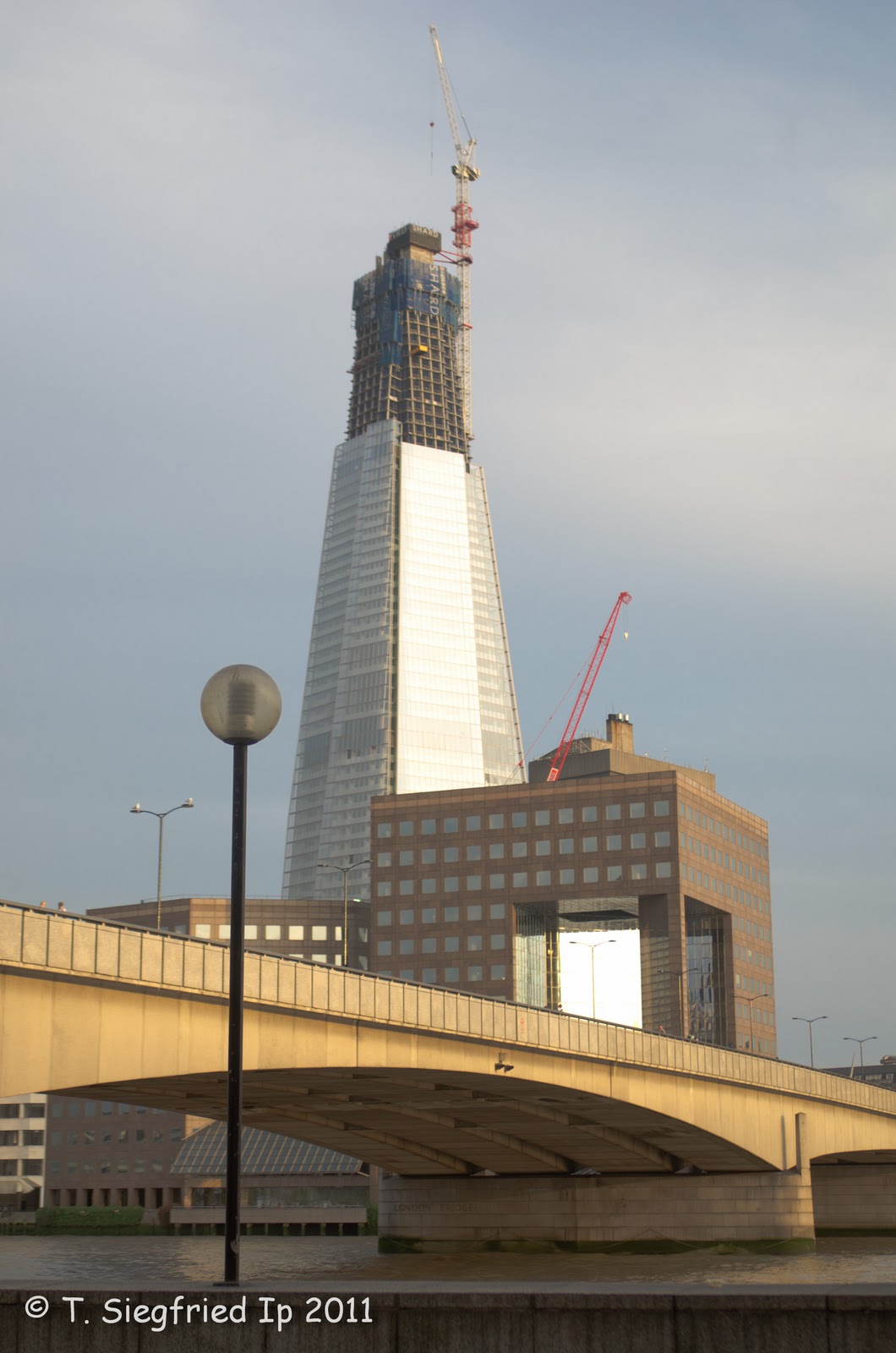
By the way, I see it all the time in football. I wonder if people just get on that way naturally or I compose them that way myself naturally.


Thursday, 12 January 2012
Review: London Riot Aftermath: Image from BBC
The truth is I feel really short of time to do the assignment in the OCA course book. Part of it is because I spend more time on the comment from my tutor. One of them is reviewing other people's image.
Here is another one that I notice on the use of symmetry. This is an image take from BBC in the London riot last year. Due to copyright issue I cannot just copy the image over here, but you can see it on this link, it is image 9 of 11.
http://www.bbc.co.uk/news/uk-14436195
The damaged car frame is in the foreground and it provides most of the structure to the image: symmetry of the car frame. Then there is the street background at the back that provide more detail of the story.
I look at this image this way: what if I do this shot without the car frame? And what if I only shoot the car frame without the street background? I would say the former will still very symmetrical but a little bit boring. Later is too typical, so even if there is damage on the street due to riot, it is hard to spot them in a board street picture.
I think even if you have a strong subject matter, it is too plain to just have it all by itself. Somehow this image works that out quite nicely.
I remember that glass picture that I shoot. As a learning experience on how to set up light, it is totally acceptable. However if I really produce glass and need to put a nice catalog sales pictures out, it is too boring. Will it stand out and get people to view? I don't think so. Background element comes in handy because it provides additional touch to give more information, make the colour more interesting, etc. It is always a difficult decision on what background to include. When I walk on the street of London, I ususally find the background is too strong that it overtakes my subject in the photograph.
There is only little time left of the next assignment, and I am planning for the shots. To be honest, I don't want to run too much risk on the background at this stage, so I am planning for minimalize style - Not totally plain, but it won't be too dramatic in shapes and colour.
Comment: UK Photography Right
I post the same post on the OCA forum. Hopefully I will get some more information to update this topic from other students.
I want to start this thread a while ago, but there is no push to look around for article. Sometime ago, I was in a weekend football match of a friend. Someone stopped me and told me that I need parents' consent if I am photographing children under 18. My problem is, I do this as a favour to my friend and have no interest in running around to collect signitures. Also, I have no idea who is under 18 and who is not.
This type of situation happens a lot. I hate picking fight in public, so I usually just give up and photograph other things instead. There are cases that people get away in photographing with their mobiles and small camera, but stuff stopped me because I have a DSLR. At the end I start looking for the relavent law with regard to this subjects. Of course, the Crown Prosecution Service website only as the list of items you cannot do, it does not clairfy what you CAN do.
Here are some of the questions I have in mind:
1) What is the restriction I need to be aware of if I were to photograph strangers in public location?
2) If I photograph stranger is venue such as British Museum, community football pitch (ie it is owned and managed by someone, although public can have free access), who is the right to set the rule for "photography"? Does it need to be published in visiable location (such as entrance) prior I photographed or stuff and manager can decide what the rule is anytime after I shoot?
3) If I were confronted by individuals, security guards, manager, etc, and ordered to delete my photograph. Do I have to compile? Or they have to get a police or court order to make me delete my photos?
4) What is the restriction on photograph children under 18? Does the law require me to obtain parents' consent before I take a shot?
5) If I take photograph for commercial purpose, under what circumstance I do not need a model release? For example, if I photograph London riot, do I need model release from the rioters before selling the photo to newspaper?
Here are the articles I came across, and they have some of the anwer to my questions.
http://www.sirimo.co.uk/wp-content/uploads/2009/05/ukphotographersrights-v2.pdf
http://pressphotos-uk.com/php/hints_tips/photographersrights.php
Monday, 2 January 2012
Exercise 23: Rhythm and Pattern
In this exercise, I have to take two photographs, one indicates rhythm (know to be dynamic repetition that the eye through a picture) and a pattern.
An example of rhythm is a line of pole that takes the eye from one edge to the centre.

The office window form a pattern and the lamp post should be breaking the pattern.

An example of rhythm is a line of pole that takes the eye from one edge to the centre.
Image 1: 50mm f4 ISO 1600 at 1/40s

The office window form a pattern and the lamp post should be breaking the pattern.
Image 2: 50mm f4 ISO 1600 at 1/40s

Subscribe to:
Posts (Atom)